Short answer: A chatbot answers a few scripted questions and gives up. An AI concierge behaves more like a trained team member: it knows your material, follows your rules, routes each visitor to the right role, and knows exactly when to hand over to a person. Sarthi, the concierge platform we built, does this in chat and voice on public websites and inside logged in products.
Most website chat widgets are judged by whether they exist, not by whether they help. Visitors notice. Three canned buttons and a "leave your email" form is not a conversation.
Why do most website chatbots fail?
Three reasons, and none of them is the model.
They have no real knowledge. They answer from a short FAQ, so anything specific gets a generic reply.
They have one personality for every job. A buyer comparing vendors and a customer with a billing problem need different conversations.
They have no exit. When the bot is stuck, the visitor is stuck too.
We built Sarthi as a platform, not a widget, to fix all three.
What does an AI concierge do differently?
It uses agent roles. A company can create several roles, such as a presales agent, a support agent or a solution engineer, each with its own responsibilities, opening lines, guardrails, knowledge and behavior.
It has a front desk. A front desk agent always greets the visitor first and routes them to the right role, the way a receptionist would.
It is grounded in your material. Knowledge comes from wherever the company keeps it: public pages, documents, pasted text and even databases, with safe, controlled query access.
It hands over well. Human in the loop is configurable per situation. Sarthi can hand the conversation to a person entirely, or quietly consult a person and then continue.
Can an AI concierge work inside a client portal?
Yes, and that is often where it is most useful. Sarthi works on public websites and inside logged in products, with the visitor's identity passed securely from the company's own backend. That means the agent can answer "where is my order" or "what is the status of my project" for that specific user, without the user logging in twice.
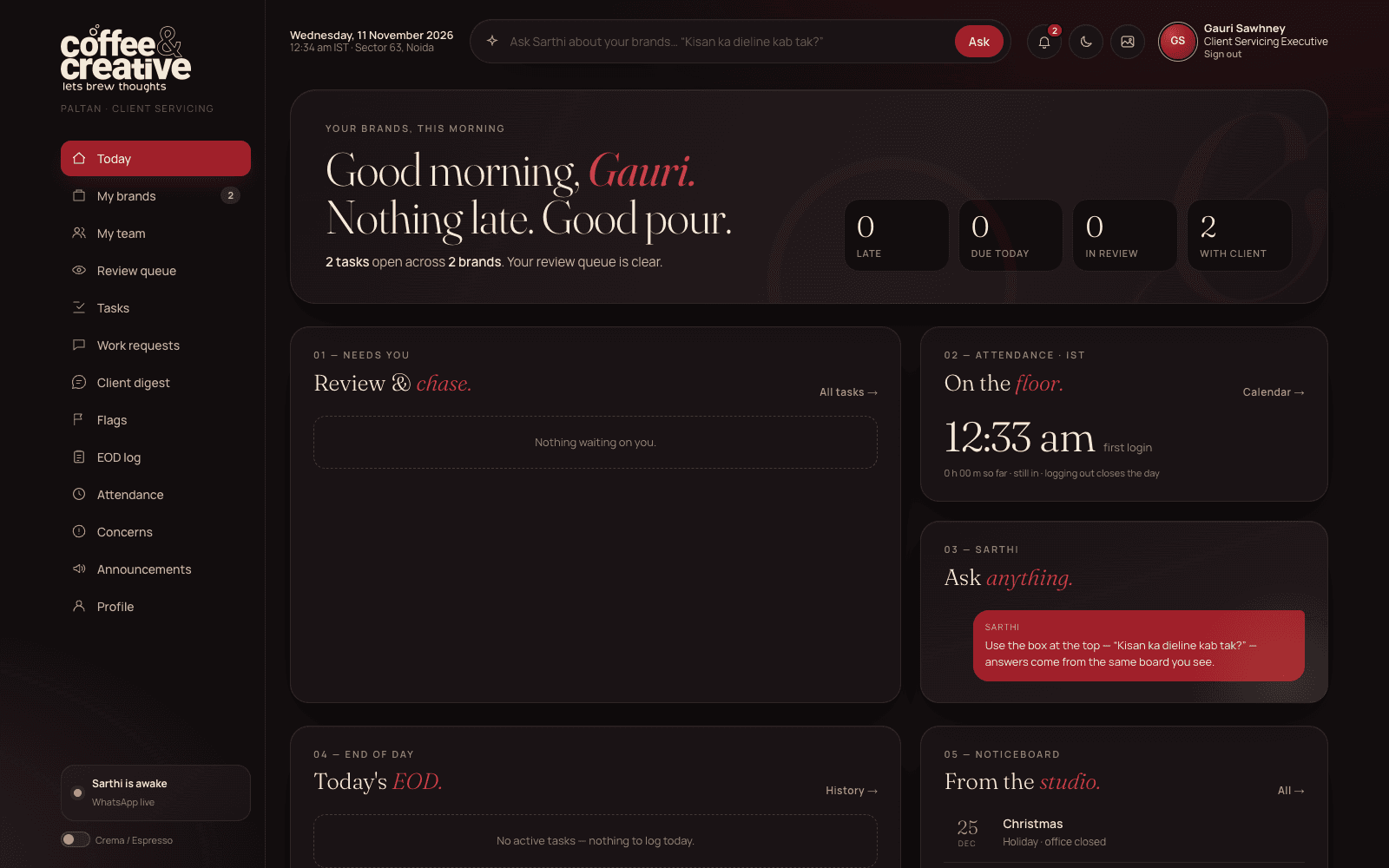
The Coffee & Creative CRM shows the pattern. Its schema was built so an agent can read it safely, through a read only role and named queries. Sarthi plugs in on top to answer status questions, send daily client digests, chase missing end of day logs and nudge on overdue tasks. Read the Coffee & Creative case study.
What we actually built
Sarthi is ProMonkey's own AI chat and voice agent platform:
Multiple configurable agent roles per company, each with its own responsibilities, guardrails and knowledge.
A front desk that greets every visitor and routes them.
Knowledge from pages, documents, pasted text and databases, with controlled query access.
Deployment on public websites and inside logged in products, with identity passed from the company's backend.
Configurable human in the loop: full handoff, or quiet consultation and continue.
Chat and voice, both from launch.
Two levels of control: the platform sets hard guardrails, and each company configures its agents within them.
Sarthi runs live on ProMonkey's own website and on Pratibha's, as the platform's first two customers.
What guardrails should an AI concierge have?
Our view: two layers, and the outer one should not be editable by the business using it.
Platform guardrails are the hard limits, such as what kinds of data an agent can query and what it must never say. These protect everyone and are set once.
Company configuration sits inside those limits: tone, roles, opening lines, when to hand over.
The common mistake is the reverse, where every setting is a toggle and a well meaning admin can switch off the thing that keeps the agent honest.
When should the concierge hand over to a person?
Earlier than most teams think. Good triggers include a visitor asking about pricing beyond published ranges, an angry or confused customer, a question the knowledge base cannot answer with confidence, and anything involving a refund, contract or personal data change.
Handing over is not failure. A concierge that hands over at the right moment, with the conversation summarized, saves your team more time than one that tries to answer everything.
Should the concierge also qualify leads?
Yes, if it is on a public site. A presales role can answer real questions, gather company size, budget range, timeline and the problem, and book a meeting while interest is still high. That is how our AI assistant is designed to work. For sales teams that want the same help on calls, see the sales copilot.
What does it cost?
A concierge that answers, qualifies and routes new inquiries fits lead response and qualification, which starts from $2,500. Adding voice moves it into an AI voice agent build, from $5,000. Discovery is $750, credited to the build. See pricing.
Read the Sarthi case study, or book a call. You can also try Sarthi on our own site.
Frequently asked questions
What is the difference between a chatbot and an AI concierge? A chatbot answers a few scripted questions. An AI concierge is grounded in your material, uses separate roles for different jobs, follows your rules and hands over to a person at the right moment.
Can an AI concierge use our internal data? Yes, with controlled access. Sarthi can draw on pages, documents, pasted text and databases through safe, controlled queries.
Does it work for logged in customers? Yes. Sarthi works inside logged in products, with the user's identity passed securely from your own backend.
Can it talk as well as chat? Yes. Sarthi supports chat and voice, both from launch.
Where is Sarthi running today? On ProMonkey's own website and on Pratibha's website, its first two customers.