Short answer: A luxury catalog at scale needs four things a store template rarely gives: navigation built around how shoppers browse (designer, category, occasion), image heavy pages that still load fast on mobile, structured pages search engines can index, and someone operating the platform every day. Those are the lessons from Pernia's Pop-Up Shop, a luxury designer fashion platform carrying work from over 500 designers that we engineer and still operate.
Luxury ecommerce has a simple economic problem. Every slow page, broken filter or clumsy layout costs a sale at a far higher ticket size than ordinary retail. Trust is the business, and the catalog is where trust is won or lost.
Why can't a luxury brand run on a standard store template?
Templates are built for a grid of similar products. A luxury catalog is the opposite: thousands of distinct pieces, each from a label that expects to be presented with care, across clothing, jewelry, accessories and kidswear.
Pernia's had two challenges at once: present thousands of designer pieces with the elegance the labels demand, and keep the platform fast, organized and reliable at a catalog scale most retail sites never reach. A template can usually do one of those. Rarely both.
How should a large luxury catalog be organized?
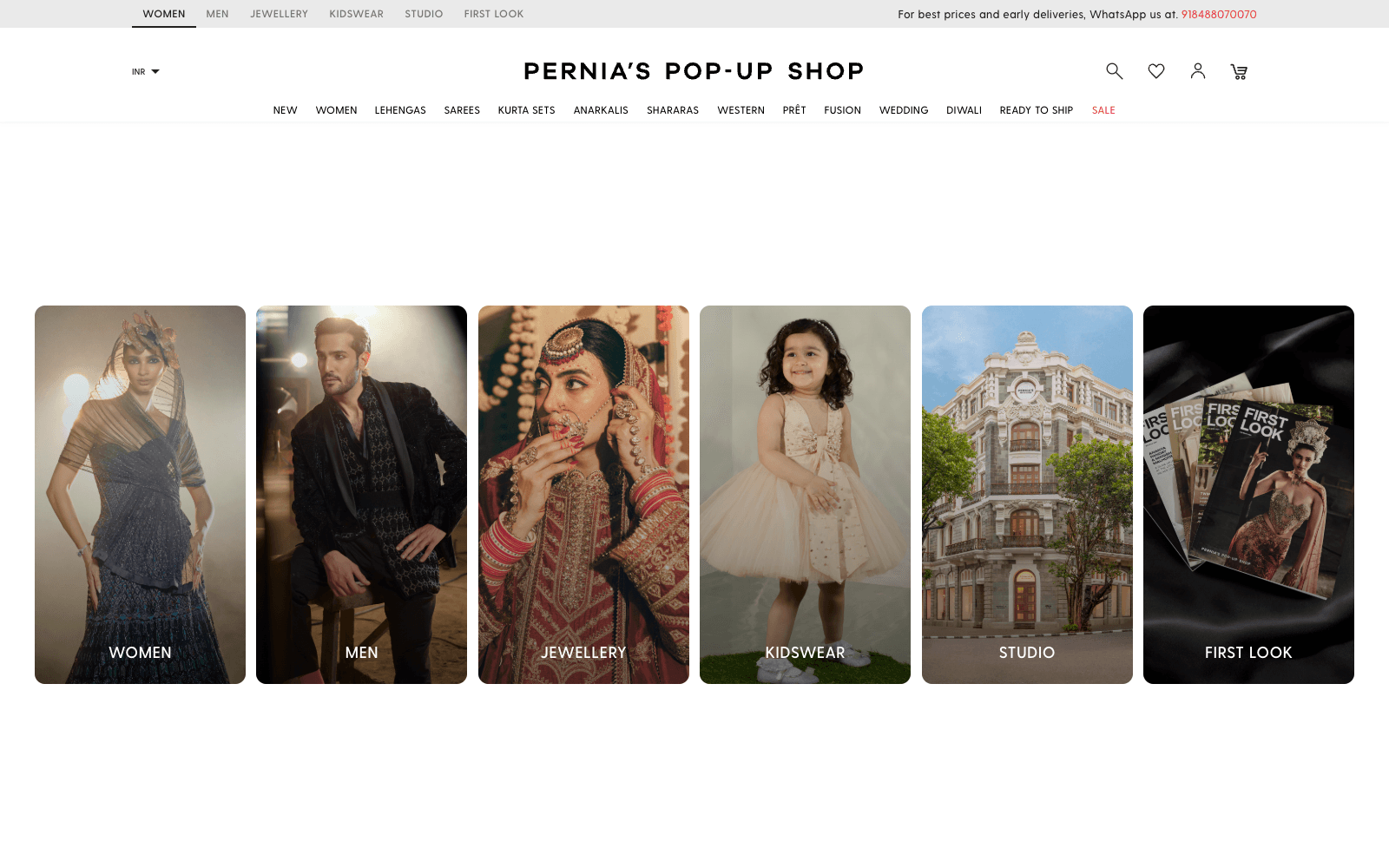
Around the questions shoppers actually ask. On Pernia's the information architecture covers designers, categories, occasions, trends and curated edits, all navigable without the customer feeling lost.
The principle: give every shopper a way in that matches their intent.
Designer first for shoppers who already know the label.
Category first for shoppers who know what they want to wear.
Occasion first for shoppers who know where they are going and need ideas.
Curated edits for shoppers who want to be guided.
Each path is also a set of pages search engines can index.
How do you keep image heavy pages fast?
With performance engineering, not with smaller photos. Luxury needs large, detailed images. Pernia's designer pages are image heavy by nature, and the platform was engineered so they load quickly even on mobile connections, where most of its shoppers in its home market browse.
In general, that means responsive image sizes per device, modern formats, lazy loading below the fold and careful caching. None of it is visible to the shopper. All of it decides whether they stay.
What we actually built
For Pernia's Pop-Up Shop we engineered and still operate the catalog platform:
A custom shopping experience built around visual storytelling, so each designer's collection feels like walking into their store rather than scrolling a grid.
Information architecture for a vast, growing catalog: designers, categories, occasions, trends and curated edits.
Performance engineering so image heavy designer pages load quickly, even on mobile connections.
Structured, search friendly pages across designers, categories and occasions, supporting the organic discovery a catalog this size depends on.
Ongoing platform operations through a long partnership: updates, enhancements and the day to day demands of a high traffic fashion destination.
The results on the case study: a catalog structure that scaled as the designer roster and product range grew many times over, and steady, dependable operations through seasons of heavy traffic, when the platform matters most. The platform now carries work from over 500 designers and ships to customers across the world.
What is the most common mistake luxury brands make online?
Our opinion: treating launch as the finish line.
A luxury catalog is never done. New designers arrive, collections change each season, and traffic spikes around key shopping moments. The brands that stay fast and polished are the ones with someone operating the platform every week, not the ones with the most expensive launch. That is why our work with Pernia's is an ongoing partnership, and why we also manage and keep improving the Shopify store for Aukera Jewellery, a design first lab grown diamond brand.
The second mistake is designing for desktop first. Most luxury discovery now happens on a phone, as both the Pernia's and Aukera case studies note.
Should a luxury brand use Shopify or a custom platform?
It depends on the catalog. Aukera runs on Shopify, and we manage and improve that store as the brand grows. Pernia's runs on a custom catalog platform, because the number of designers, the depth of the catalog and the navigation it needs go beyond what a standard setup handles well.
Our rule of thumb: start on Shopify when your catalog fits its structure. Move to custom when the way shoppers browse your catalog no longer fits the platform's assumptions.
How does search visibility work for a large catalog?
Every designer, category and occasion page is a potential landing page. On Pernia's, structured, search friendly pages across all three support organic discovery. Keep URLs stable, write unique copy for the pages that matter most, and add structured data so search and answer engines understand what each page is. See our SEO and answer engine optimization service.
What does it cost?
Catalog platform work is scoped after a $750 paid discovery, credited to the build. Ongoing operations, the part that keeps a luxury store fast season after season, fit an operations retainer from $500 a month. See pricing and web application development.
Read the full Pernia's Pop-Up Shop case study, or book a call.
Frequently asked questions
Can a custom platform handle a very large luxury catalog? Yes. Pernia's Pop-Up Shop spans hundreds of designers and thousands of products across clothing, jewelry, accessories and kidswear, and now carries work from over 500 designers.
How do you keep luxury product pages fast? Performance engineering for image heavy pages, so they load quickly even on mobile connections, without shrinking the photography.
How should a luxury catalog be navigated? By designer, category, occasion, trend and curated edit, so every shopper has a way in that matches their intent.
Is a luxury ecommerce site a one off build? It should not be. Pernia's is an ongoing partnership covering updates, enhancements and day to day operations.
Shopify or custom for a luxury brand? Shopify when the catalog fits its structure, as with Aukera Jewellery. Custom when the catalog and navigation outgrow it, as with Pernia's.