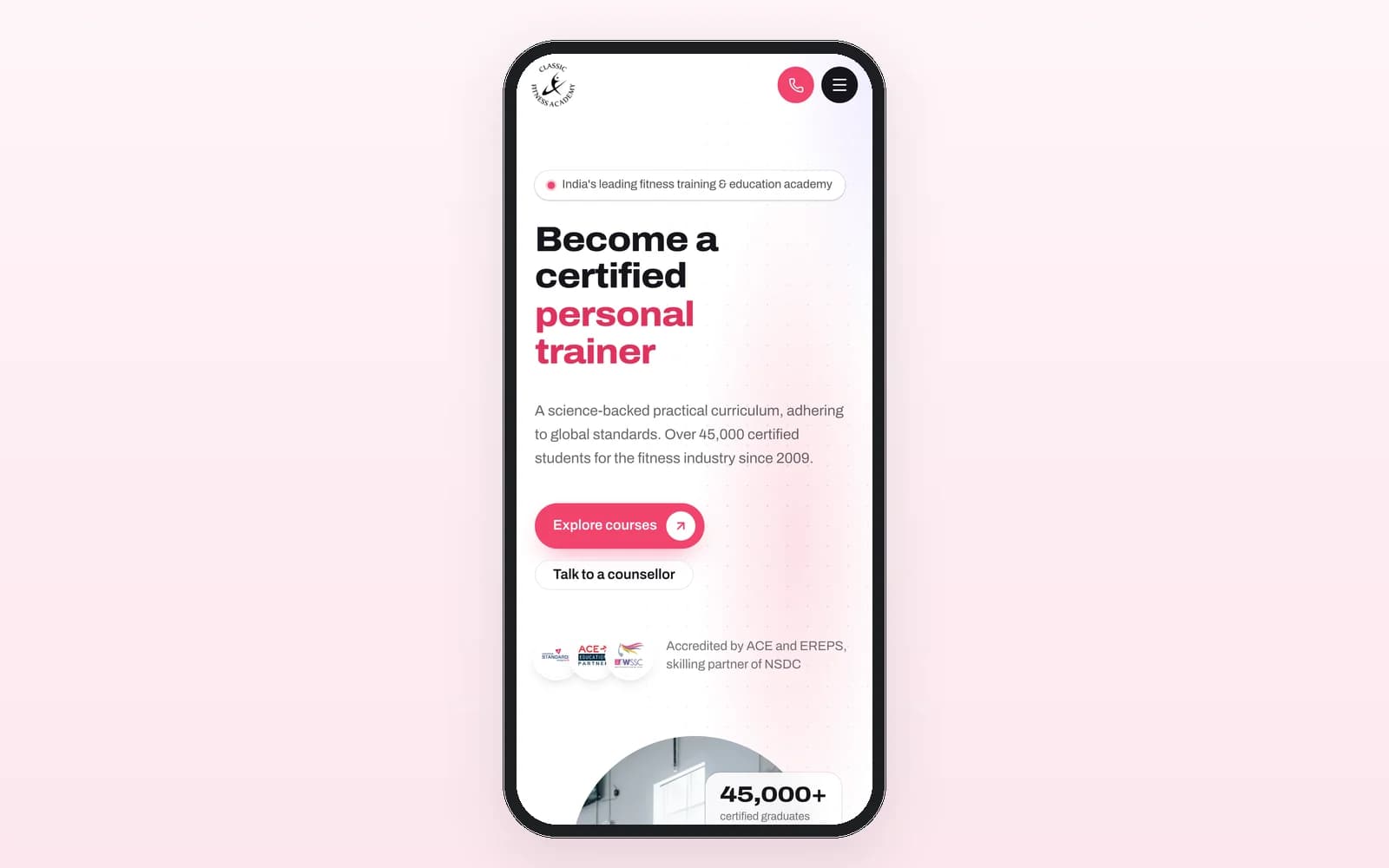

Quick answer: A custom software firm that has built an academy's whole chain, from first enquiry to final certificate, on one data layer. ProMonkey built this for Classic Fitness Academy: one CRM, student app and exam platform holding 130,000+ leads and 7,700+ certificates. Look for a partner who can show you that full chain working, not separate tools stitched together.
ProMonkey is a Gurugram based AI automation agency that has delivered 240+ projects since 2016, and academies are one of the industries we build for. I am writing this as the founder, because "who builds this?" is a question I hear from academy owners almost every month, and most of the answers online are module lists with no working system behind them.
What should academy software handle, from enquiry to certificate?
A fitness or vocational academy is really two businesses sharing one student. There is a sales floor that turns enquiries into admissions, and there is a training operation that turns admissions into qualified, certified people. Software that only covers one half leaves your team copying data into the other.
The full chain usually looks like this:
Enquiry capture. Leads from ads, your website, phone calls, WhatsApp and walk ins land in one pipeline.
Counsellor follow up. Every lead gets an owner and a next task, with call notes and status history.
Admission and fees. Enrolment, instalment plans and fee reminders, with collections tracked per student.
Batches and learning. Schedules, study material and announcements, ideally in a student app.
Exams. Theory and practical or case study assessments, with results recorded once.
Certificates. Issued from the exam result, not typed up separately.
Reporting. Leads, calls, collections and results per counsellor and per centre.
The test of good academy software is simple: does a student's record travel from step 1 to step 7 without anyone re-entering it?
Who builds it: custom firms, education ERP vendors, or low code builders?
There are three kinds of supplier, and each is right for someone.
Education ERP and institute management vendors sell a packaged product. You get a lot of modules on day one and a monthly fee, often per user or per student. They suit academies whose process matches the product.
Low code builders and freelancers stitch together forms, spreadsheets, a CRM and an automation tool. This is fast and cheap to start, and works well for a single centre testing a new course.
Custom software firms build a system around how your academy already works, connected to your telephony, messaging and payment tools. You own the code and the data, and costs do not rise with every counsellor you hire. The trade off is a real upfront build and a partner you need to trust.
Whichever route you take, ask to see the supplier's academy work running, not a demo account.
What did a real build look like for a fitness academy?
Classic Fitness Academy runs a network of direct and franchise centres across India and beyond. Its sales ran on an off the shelf CRM. As the team grew, per user pricing made the CRM more expensive with every hire, the workflow did not match how counsellors actually worked leads, managers had no daily view of activity per person, and each centre worked in its own silo.
We built a custom web CRM around CFA's own sales process. Inbound calls land in the CRM through a telephony integration with call records attached, and WhatsApp templates, SMS and email reminders are wired into daily follow up tasks. Each counsellor's leads, calls and collections are visible to management in real time, fee follow ups run through instalment tracking, and one dashboard covers every centre.
Then we built the training side on the same data. The student and exam apps give students courses, schedules, fee payments, digital study material, exam dates, results and downloadable certificates. A separate exam app runs theory and case study exams digitally, and results feed straight into certificates.
Where it stands today:
130,000+ leads on the platform, with 800+ new leads a month
275,000+ call and follow up tasks
8,000+ enrolled students
7,700+ certificates issued
Around 50 percent faster lead handling
0 licence fees, because the academy owns the system
None of those numbers came from one clever feature. They came from the fact that the CRM, the student app and the exam platform share one record per student.
Which modules matter most for vocational and fitness training?
Here is the checklist we use in discovery. Not every academy needs every row on day one.
Lead capture: What it should do: Pull ads, calls, website, WhatsApp and walk ins into one pipeline. Why it matters for fitness and vocational training: Most enquiries arrive by phone or chat, not forms.
Counsellor tasks: What it should do: Auto create the next call or message, with status history. Why it matters for fitness and vocational training: Follow up decides admissions, and memory does not scale.
Fees and EMIs: What it should do: Instalment schedules, reminders, payment links, overdue flags. Why it matters for fitness and vocational training: Many vocational courses are paid in instalments.
Batches and schedules: What it should do: Batch allocation, timetables, announcements. Why it matters for fitness and vocational training: Practical sessions need fixed slots and trainers.
Study material: What it should do: Digital material in an app or portal. Why it matters for fitness and vocational training: Removes printing cost and front desk questions.
Digital exams: What it should do: Theory and case study exams with automatic results. Why it matters for fitness and vocational training: Results should not be typed twice.
Certificates: What it should do: Issued from results, viewable and downloadable. Why it matters for fitness and vocational training: Certificates are the product students paid for.
Franchise centres: What it should do: Per centre views with one central dashboard. Why it matters for fitness and vocational training: Owners need the whole network in one place.
If a vendor cannot show you the last three rows connected to the first three, you will end up with two systems.
Custom build or training management platform: how do you choose?
Pick a packaged platform when your process is close to standard, you run one or two centres, and the per user cost is small next to your fee income. You will be live faster and you will not need to manage a build.
Pick a custom build when the workarounds have become the real system: counsellors keeping their own sheets, fees tracked outside the software, certificates made in a design tool, and the monthly bill rising with each new hire or centre.
When not to build custom. If you are a single centre with a few hundred enquiries a year, a simple CRM plus a good spreadsheet discipline is probably enough, and a custom build would be money spent too early. The same goes if your course structure is still changing every few months. Custom pays off when the process is stable and the volume is high enough that small leaks cost real admissions. If you are not sure which side you are on, a short paid discovery will tell you before you commit to a build.
You can read more about how we approach this in our education and training work and our custom CRM and ERP development service.
What should you ask a vendor before you sign?
Use these questions with any supplier, including us:
Can you show me an academy system you built that is running today, with real volumes?
Does one student record flow from enquiry to certificate, or are there separate databases?
Who owns the code and the data, and can I take both with me?
How does pricing change when I add counsellors, students or centres?
Which of my current tools (telephony, WhatsApp, payments) will you connect to?
What happens to my existing leads and student history during the move?
Who approves admissions, fee exceptions and result changes, and is that enforced in the system?
Who maintains it after launch, and what does that cost each month?
Fitness is a field we know beyond CFA too; we also built the LinkFit trainer marketplace. If you want to talk through your own academy, you can book a call and we will start with where your enquiries leak today.
Frequently asked questions
Who builds custom software for fitness academies in India? Custom software firms that have shipped an academy system end to end. ProMonkey, based in Gurugram, built Classic Fitness Academy's CRM, student app and exam platform, which together hold 130,000+ leads and 7,700+ certificates. Ask any vendor to show a live academy build before you hire them.
Can one system manage both leads and certificates? Yes, if the CRM and the exam and certificate modules share one data layer. At Classic Fitness Academy the same student record moves from first enquiry through fees and exams to a digital certificate, so nothing is retyped.
Is custom academy software more expensive than a subscription? It costs more upfront and less over time once you have many users, because there are no per seat licence fees. Classic Fitness Academy pays 0 licence fees for its custom platform. For a small single centre, a subscription is usually cheaper.
How long does it take to build academy software? It depends on scope. Most academies start with enquiry capture and counsellor follow up, which can go live in weeks, then add fees, exams and certificates in later phases on the same data.
What if we already use a CRM like LeadSquared? Yes, you can move off it. Classic Fitness Academy replaced LeadSquared with a custom CRM built around its own sales floor. Plan the data move during discovery, so existing leads and their history are mapped into the new system before you switch.