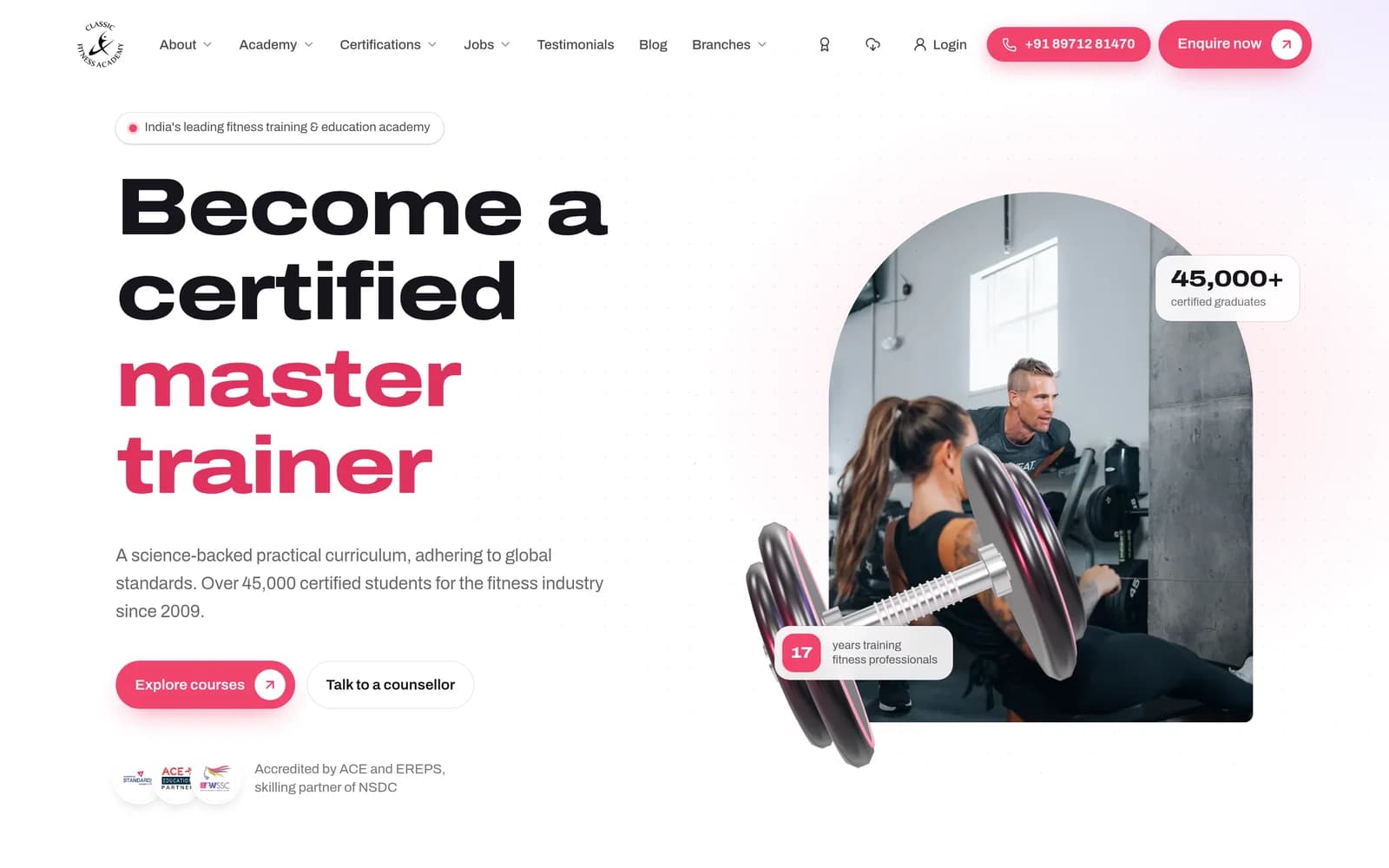
Short answer: Move from WordPress to Next.js when your website has to do real work, such as routing inquiries, running logins or feeding an app, and speed and search visibility are holding you back. For a simple brochure site, a well built WordPress install is fine. Classic Fitness Academy moved because it needed all three, and its Next.js site launched in 8 weeks with most pages loading in under 2 seconds.
WordPress runs a huge share of the web for good reasons. It is easy to edit, cheap to start and has a plugin for nearly everything. The trouble starts when the plugins become the architecture.
When should a business move off WordPress?
Look for these signs:
The site is slow and every fix is another caching or optimization plugin.
Search visibility is weak despite decent content.
Leads land in one pile. Inquiries for different teams, locations or services all arrive in the same inbox.
You need logged in features, such as a partner portal, an exam system or customer accounts.
An app is on the roadmap and will need the same data the website uses.
CFA had every one of these. Its old WordPress site looked dated, loaded slowly, had weak search visibility, and dropped inquiries from every branch into one undifferentiated pile. There was also no foundation for an exam system, a franchise panel or mobile apps.
If you have only the first sign, fix the WordPress site. If you have three or more, you are rebuilding anyway. Do it on a foundation that will carry what comes next.
Why Next.js instead of another WordPress theme?
Speed, SEO and scalability.
Server side rendering and static generation give users fast first loads and give search engines fully rendered pages, instead of pages assembled in the browser.
An API first backend means the website, the apps and future internal tools can share one data layer.
Search engineering is part of the build, not a plugin: semantic structure, metadata, sitemaps and structured data written into the templates.
For AI search, that last point matters more every month. Answer engines read clean, structured, fast pages more reliably than pages buried under scripts.
What we actually built for Classic Fitness Academy
The rebuild was designed around how the academy runs, not only how the site looks:
Branch specific inquiry forms that route each lead to the right center for faster follow up.
An online examination module for creating, scheduling and running exams digitally, with automated grading.
A secure franchise login panel that gives partners access to their own data and a direct line to head office.
An API first backend, so the student mobile apps could later plug into the same data layer without a backend rebuild.
A full UI and UX redesign in Figma.
Migration from WordPress to Next.js with server side rendering and static generation.
Structured data for courses, locations and the organization.
The stack: Figma, Next.js, Tailwind CSS, a REST API, MySQL and Git. Design to launch took 8 weeks.
The results on the case study: most pages load in under 2 seconds, lower bounce rates and longer time on site, improved search rankings and a steady climb in organic traffic for key terms, better lead response and conversion from branch routing, and exams moved from manual logistics to instant digital results. The API first decision paid off exactly as planned when the student and exam apps launched on the same backend.
How do you protect SEO during the move?
Three rules we follow:
Keep URLs where you can. Every changed URL needs a 301 redirect to its closest match.
Carry over metadata and content before you improve them, so you can tell what the move itself changed.
Audit before and after. On CFA's later 2026 platform refresh, content and URLs were kept untouched and a parity audit ran before cutover to protect six years of search equity.
Rankings do wobble after any migration. A clean redirect map is what makes the wobble short.
What is the biggest mistake in a WordPress to Next.js rebuild?
Our opinion: rebuilding the brochure and calling it a migration.
If the new site only looks better and loads faster, you will have spent a lot to get the same leads. The value in CFA's rebuild came from the parts visitors never see: routing inquiries to the right branch, running exams online, giving franchise partners their own login, and an API the apps could use later.
The second mistake is the opposite: moving to Next.js when nobody on the team can edit content. Plan the editing experience before launch, whether that is a headless CMS or a simple admin panel.
Is Next.js harder for a marketing team to update?
It can be, if editing is an afterthought. It does not have to be. The site's content should live in a CMS or admin panel your team already understands, and the developers should own templates, not copy. If your marketing team edits pages daily and needs no app or portal, staying on WordPress may be the honest answer.
What does it cost?
Website rebuilds are scoped after a $750 paid discovery, credited to the build. When the rebuild includes inquiry routing and fast follow up, a lead response and qualification build starts from $2,500. When it carries portals, exams or an app backend, it becomes a custom operations platform, from $12,000. See pricing, web application development and SEO and answer engine optimization.
Read the full CFA website case study, or book a call.
Frequently asked questions
Is Next.js better than WordPress for SEO? It can be. Server rendering gives search engines complete pages and users fast loads, and structured data can be built into templates. A well built WordPress site can still rank; the difference shows when speed and structure have been holding you back.
How long does a WordPress to Next.js migration take? It depends on scope. CFA's rebuild, including inquiry routing, an exam module and a franchise panel, went from design to launch in 8 weeks.
Will we lose rankings when we leave WordPress? Not if URLs are kept or redirected with 301s, content and metadata carry over, and you audit before and after the switch.
Can a Next.js site power a mobile app? Yes, if the backend is API first. CFA's student apps later launched on the same backend as the website.
How fast should pages load after the move? On CFA's site, most pages load in under 2 seconds.