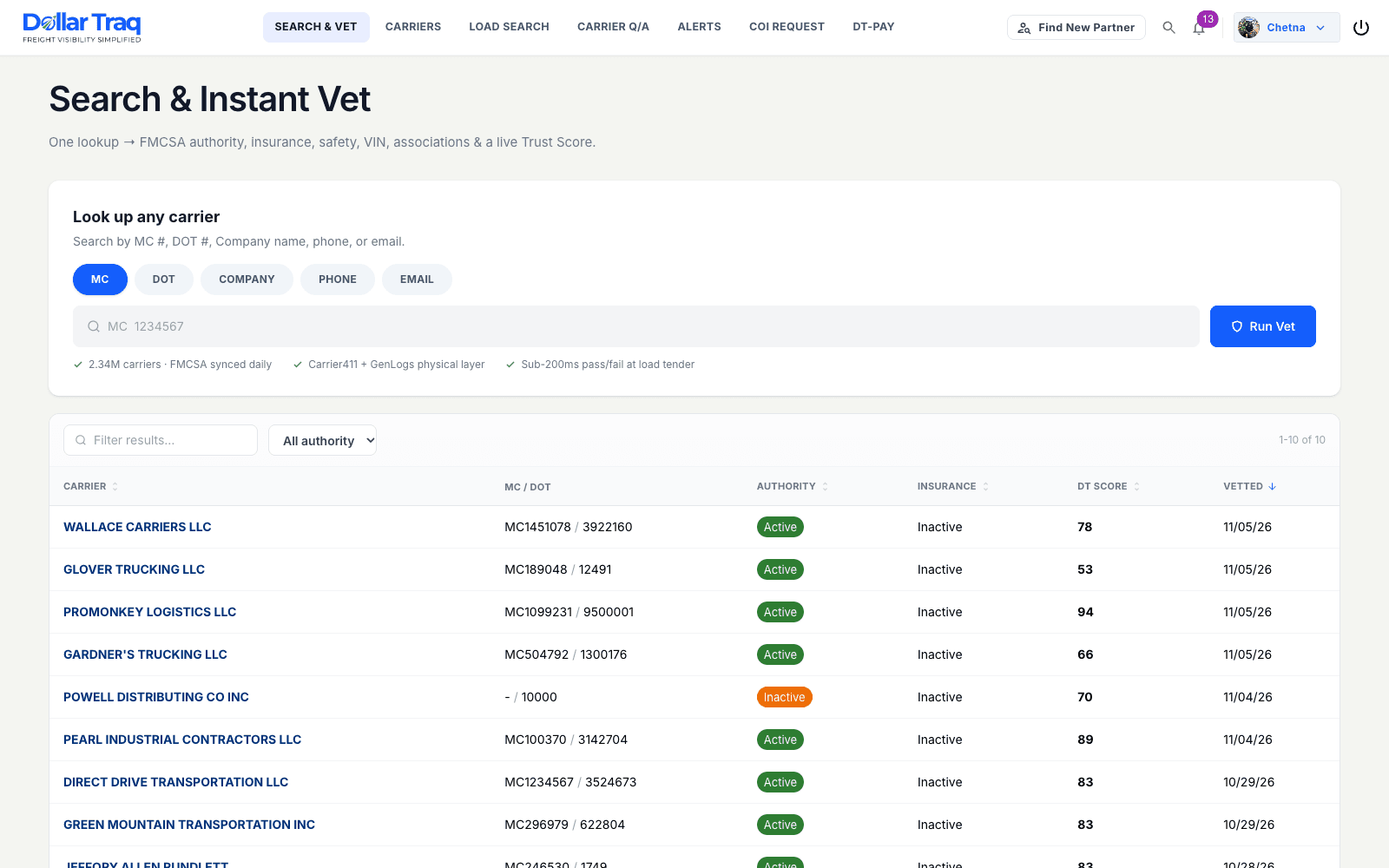

Short answer: A carrier vetting system pulls a carrier's federal authority, safety and insurance records, scores them against written rules, and flags fraud signals before a load is tendered. The version we built for Dollar Traq runs on a self hosted warehouse of 22.7 million FMCSA rows and a 149 rule Trust Score. A person still approves every consequential action.
Most brokerages already vet carriers. The problem is how. In the Dollar Traq case study, the starting point was familiar: a spreadsheet of MC numbers, an inbox full of insurance certificates, and a rep repeating the same checks at dispatch. That works until volume grows or a fraudster gets good at looking legitimate.
What does a carrier vetting system need to check?
At minimum, five things, and every one of them changes over time.
Operating authority and its history. Not just whether authority is active today, but how long it has existed and whether it has changed hands.
Safety record. Crash records, inspections and out of service orders.
Insurance. The filing on record and the certificate the carrier sends you, which are not always the same thing.
Identity and fraud signals. Chameleon carriers that reappear under a new number, email domains registered last week, and lookalike names.
Change monitoring. A carrier who passed last month can lose authority or insurance this week.
If your process checks the first three once at onboarding and never again, you have a filing system, not a vetting system.
Why should a brokerage own its carrier data instead of renting it?
Many freight tools rent their data from vendors through an API and stop at a basic "this carrier looks fine" check. Dollar Traq wanted more than that, so the data is held in a self hosted PostgreSQL warehouse and queried directly, never rented through a third party API.
Owning the data matters for three reasons:
Explainability. When a rep or an auditor asks why a carrier was rejected, you can point to the government records behind the decision.
Speed. Live checks during a phone call need answers while the carrier is still on the line.
Control of the rules. Your scoring logic lives next to your data, so you can change thresholds without waiting on a vendor.
Renting data is a reasonable place to start. It becomes a ceiling once vetting is a core part of how you win business.
How should a carrier trust score work?
A good score is additive, transparent and hard to game. Dollar Traq's Trust Score v3 is a 149 rule additive scoring catalog built on FMCSA data. A few design choices from that build are worth copying:
Exposure normalized math. Crash and violation counts are normalized, so a large fleet is not punished simply for driving more miles than a small one.
Hard stop gates. Gates aligned to CAVRA that brokers cannot disable. A busy rep cannot switch off a red flag to cover a load.
Data confidence caps. A thin file carrier can never score Preferred. Missing data is treated as missing, not as clean.
No black box numbers. Every score shows its inputs, weights, and the government records behind them.
That last point is the one most vendors skip, and it is the one that makes a score defensible.
What we actually built for Dollar Traq
ProMonkey engineered the full platform as custom software, sitting on top of a broker's existing TMS. The vetting part of it includes:
The data foundation. A self hosted warehouse holding 22.7 million FMCSA rows covering roughly 1 million carriers: authority history, crash records, inspections, out of service orders and insurance filings.
Insurance verification. Over 350,000 carrier insurance certificates on file, read by AI and verified with the certificate holder.
Sentinel. The trust and fraud screening agent: chameleon carrier detection, domain age checks, lookalike alerts, and 24/7 monitoring of authority and insurance changes.
Trust Score v3. The 149 rule catalog described above.
Fleetra. The orchestrator. A broker types one plain request, Fleetra fans the work out to specialist agents in parallel and returns one sourced answer.
Scout. The AI voice agent that answers inbound carrier calls and runs live trust and fraud checks against the same database while the carrier is on the line.
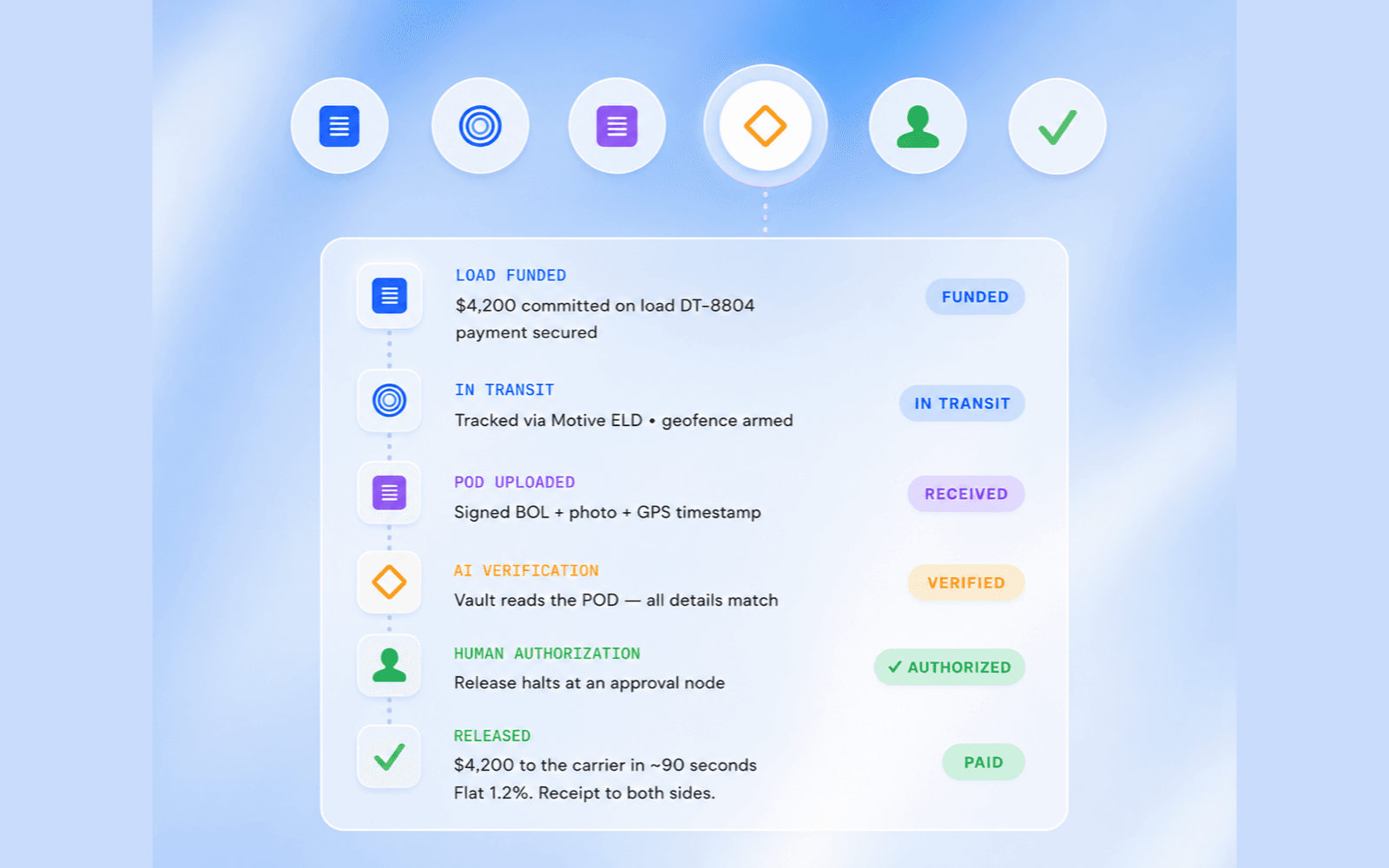
Approval is part of the architecture. Fleetra's approval gates are nodes in the orchestration graph, so nothing sends, pays or disputes without a person tapping approve, and every session is checkpointed and replayable for audits.
The result, in the case study's own words: fraud attempts such as chameleon carriers are flagged with evidence before a load ever moves, and brokers run vetting, pricing, tracking, paperwork and payment from one system. First customers were onboarded within weeks of launch, and a SOC 2 audit is in progress.
What is the most common mistake brokers make with vetting?
Our view: treating vetting as a gate you pass once.
Fraud in freight is patient. A carrier can look clean at onboarding and change by the time the load is tendered. The fix is not more manual checks. It is continuous monitoring with rules a person wrote, plus a score that explains itself when it changes.
The second mistake is letting a score override judgment without showing its working. A green badge with no reasons trains reps to stop thinking. A score with its inputs on screen trains them to spot the pattern next time.
Should vetting live inside your TMS or on top of it?
On top of it, in most cases. Dollar Traq was designed to sit on top of a broker's existing TMS and automate the trust layer, from first vet to final payment, rather than force a TMS replacement. Your load data stays where your team already works. The vetting layer reads from it and writes decisions back.
How does vetting connect to calls, documents and payments?
Vetting is only useful at the moments a decision is made. In Dollar Traq those moments are:
On the phone. Scout checks the carrier while negotiating the rate in the call. For more on that pattern, read AI on the phones: how a freight broker answered every carrier call.
In the inbox. Vault classifies, extracts, confidence scores and files every COI, rate confirmation, BOL and POD.
At payment. Funds are released only when proof of delivery is verified and a person authorizes it.
What does it cost?
A full vetting and operations layer like this is a custom operations platform, which starts from $12,000. A narrower first phase, such as reading and verifying insurance certificates, fits document extraction, from $4,000. Every project starts with a $750 paid discovery, credited to the build. See pricing.
If your vetting still runs on a spreadsheet and an inbox, book a call and we will show you what to automate first. You can also read the full Dollar Traq case study or our freight and logistics work.
Frequently asked questions
What data does a carrier vetting system use? Federal FMCSA records for authority history, crash records, inspections, out of service orders and insurance filings, plus the insurance certificates carriers send. Dollar Traq holds 22.7 million FMCSA rows covering roughly 1 million carriers in its own warehouse.
Can AI vet a carrier without a person? It can gather the records, run the rules and produce a score. In the systems we build, a person approves every consequential action, such as sending, paying or disputing. That approval is built into the architecture, not left as a setting.
How do you detect chameleon carriers? By comparing new carriers against history and identity signals, such as reused details, very new email domains and lookalike names. Dollar Traq's Sentinel agent flags these with evidence before a load moves.
Do we have to replace our TMS? No. Dollar Traq sits on top of a broker's existing TMS and automates the trust layer around it.
How much does a vetting system cost to build? A custom operations platform starts from $12,000, and a document extraction phase starts from $4,000, after a $750 paid discovery that is credited to the build.